
Introduction
Cash pooling is a liquidity structure that treasury departments implement by concentrating all their companies' cash into one central master account that their companies can lend to or borrow from. An entity acting as the cash pool leader (usually the group's parent company or a dedicated treasury company) manages the central master account. From there, only the consolidated net balance pays interest to/ receives interest from an external bank. Significant advantages can thus be obtained by the group through this cash consolidation, though certain challenges will also be addressed in this blog.
Pros and Cons of Cash Pooling
Benefits
Cash pooling results in various benefits for multinational company groups:
-
A better overview of the liquidity across the company group.
-
Easier access to short-term liquidity, resulting in lower risk of individual companies in the group being short on cash.
-
Lower interest costs:
- Participating companies essentially borrow from each other through the cash pool master account, as opposed to each participant borrowing from a bank, which have a larger spread (see example below).
- Better bank interest rates, since only the cash pool master account interacts with the bank, and it does so with the much larger consolidated balance.
Drawbacks
Although there are many benefits, especially for large organisations, cash pooling does come with its own set of challenges that must be taken into account:
- Local regulations may or may not permit different types of cash pooling.
- Participating companies lose some financial independence, as a centralised treasury entity manages the group's liquidity.
- Importantly, transfer pricing regulations must be taken into account, when cash pools are implemented across jurisdictions.
Cash Pool Example
Different types of cash pools exist; from simple physical and notional cash pools to more complex hybrids and multi-layer, multi-currency cash pools.
Below is a comparison between a group's companies' balances and their interest payables when they are without a cash pool (each company withdraws and deposits with their bank directly) and a simplified example of a physical cash pool. The examples follow the principles outlined in the International Manual on Cash Pooling by the HMRC.
Group Company Balances Without a Cash Pool
| External Withdrawal (at 4%) | External Deposit (at 2%) | ||
|---|---|---|---|
| Company | Funding needed (-) | Excess funds held (+) | Interest Payable/ Receivable |
| A | -400,000 | -16,000 | |
| B | -100,000 | -4,000 | |
| C | 300,000 | 6,000 | |
| D | 200,000 | 4,000 | |
| Net amount | -500,000 | 500,000 | -10,000 |
Notice how the total interest earned is 10,000 and the total interest paid is 20,000. This results in a net group interest cost of 10,000, although the group overall is perfectly balanced at a net balance of 0. The group still pays interest to third-party banks due to separate banking.
Group Company Balances With a Cash Pool
Now, let's look at the same balances but consolidated into a central master account as part of a cash pool arrangement.
| Internal Pool Withdrawal (at 3.25%) | Internal Pool Deposit (at 2.75%) | |||
|---|---|---|---|---|
| Company | Funding needed (-) | Excess funds held (+) | Interest Payable/ Receivable | Benefit/ Synergy |
| A | -400,000 | -13,000 | 3,000 | |
| B | -100,000 | -3,250 | 750 | |
| C | 300,000 | 8,250 | 2,250 | |
| D | 200,000 | 5,500 | 1,500 | |
| Net amount | -500,000 | 500,000 | -2,500 | 7,500 |
In this case, debit and credit balances perfectly offset each other, resulting in a cash pool's net balance is 0. Therefore, its central master account does not pay or receive interest to or from the bank.
Interest still needs to be paid internally between the companies lending to and borrowing from each other through the cash pool, though this too occurs via the cash pool master account and without an external bank's interest spread. There still is a margin between withdrawals and deposits, which in this case results in a 2,500 interest spread - commonly allocated to/ retained by the cash pool leader (the entity managing the cash pool).
As illustrated in the example above, the cash pool structure can greatly decrease interest costs for its participants (and the group as a whole) by offsetting balances and keeping interest payments within the group. In this example, a net benefit, or synergy, of 10,000 (7,500 for the participants and 2,500 for the cash pool leader) was created by entering into a cash pool arrangement.
The internal interest rates (the transfer price) and cash pool leader's spread remuneration are discussed in the next chapters.
Transfer Pricing in Cash Pools
Transfer pricing is the setting of the "price" of a transaction between related parties; in this case, the interest rates for the deposits and withdrawals between the cash pool leader/ central master account and its participants. The transfer price should follow the arm's length principle, i.e. be comparable to the price that would be paid if the transaction occurred between unrelated parties under similar conditions.
Due to transfer mispricing, taxable income can be moved to tax havens through interest payments. The OECD revealed that up to $240 billion are lost annually in tax revenue through transfer mispricing of deductible payments like interest - an amount equivalent to 10% of global corporate income tax revenue. Tax authorities are therefore increasingly scrutinising and auditing these internal interest rates.
Transfer Pricing Considerations
Cash Pool Synergy
Synergies arise in the cash pool due to the offsetting of balances and interest on the net balance. In short, synergy can be described as the benefit created by participating in the cash pool when compared to seeking financing or depositing cash externally, i.e. with a bank.
This synergy created can be quantified overall for the cash pool, as well as per participant. The OECD Transfer Pricing Guidelines stipulate that this cash pool benefit should be distributed among the participants according to their contributions, as opposed to being retained by the cash pool leader.
Cash Pool Leader's Remuneration
When credit and debit balances offset each other, the cash pool leader must not simply retain all of the spread between the credit and debit interest rates. Transfer pricing guidelines explain that an analysis must be performed to determine the functions assumed, risks borne, and assets used by the cash pool leader in order to determine how much of the spread is to be retained by the leader and how much is to be allocated to the cash pool participants.
Structural Position Risk
Another notable transfer pricing risk may arise when a participant's balance in the cash pool become structural. If a participant maintains a debit or credit position for an extended amount of time, tax authorities may want to reclassify it as a long-term loan, which implies an adjustment to quite different interest rates than the short-term interest rates found in cash pools.
Internal Cash Pool Interest Rates
It's up to the multinational groups to set these internal intercompany interest rates, which is where transfer pricing issues commonly arise. Cash pools' internal interest rates do not tend to be publicly disclosed, and with the synergy and spread remuneration considerations in mind, one cannot simply benchmark and compare internal cash pool interest rates with external bank interest rates.
With the OECD's update of its Transfer Pricing Guidelines in 2022, a whole new section on cash pool transfer pricing was added. Chapter X, Section 3 outlines important considerations and steps that need to be taken in order to calculate suitable arm's length interest rates for the cash pool participants and spread remuneration for the cash pool leader.
Every time participants' balances are pooled, synergies and interest spreads arise. They differ depending on the balances and interest rates in the cash pool and are interrelated. Calculating them for each participant, every time balances are consolidated in the cash pool (usually daily) is a tedious task, but indispensable for proper adherence to OECD Transfer Pricing Guidelines. Though it won't be an issue for small pools with few participating companies, larger cash pools will take up significant resources when manually calculating the synergies created.
Most treasury management systems (TMS) miss the transfer pricing component of cash pooling and leave it up to treasury and tax departments to do it manually. On the other hand, transfer pricing benchmarking tools may provide tax departments with participants' baseline arm's length rates, but lack the context and calculation of synergies and spread created in cash pools - resulting in transfer pricing audit risk.
Notable Court Cases
The cash pool leader is often situated in a jurisdiction with favourable withholding tax rates and treaties, such as Luxembourg or The Netherlands. At times, cash pools structures have been abused by setting unrealistic internal interest rates or cash pool leader remuneration, artificially shifting profits to companies in low-tax countries. Generally, the OECD's Transfer Pricing Guidelines (specifically Chapter X on financial transactions) are what different jurisdictions have ratified and implemented into domestic tax law.
Several notable court cases that resulted from cash pool transfer pricing audits have occurred in the last decade - the most recent of which established a landmark precedent on cash pooling in Spain.
-
In the 2025 Spanish Supreme Court ruling Spain v. Bunge Ibérica (Bunge Group), tax authorities claimed that:
- Interest rates applied to deposits and borrowings were asymmetric and not at arm's-length (using standalone credit ratings, as opposed to the consolidated group's credit rating).
- The cash pool leader assumed no financial risks and merely had an administrative role, which therefore did not justify retaining an interest spread.
-
In 2024, the Italian Supreme Court ruled on the case of Italy v. Arvin Replacement Products. The case arose from a tax audit, in which the tax authorities recharacterised a cash pooling agreement as a medium-to-long-term loan, based on:
- An Italian subsidiary consistently maintained a credit position (resulting in a structural position).
- Transfers to the cash pool did not occur daily, only periodically.
- The subsidiary retained significant liquidity and operated independently.
-
In the 2016 Norwegian Supreme Court ruling Norway v. ConocoPhillips, tax authorities claimed that:
- Interest rates applied to deposits were not at arm's-length.
- The synergies of the cash pool were not split among the participants in accordance with their respective contributions.
Conclusion
While cash pooling is an excellent way for treasury teams to optimise liquidity in the company group and minimise interest costs, it comes with certain transfer pricing challenges.
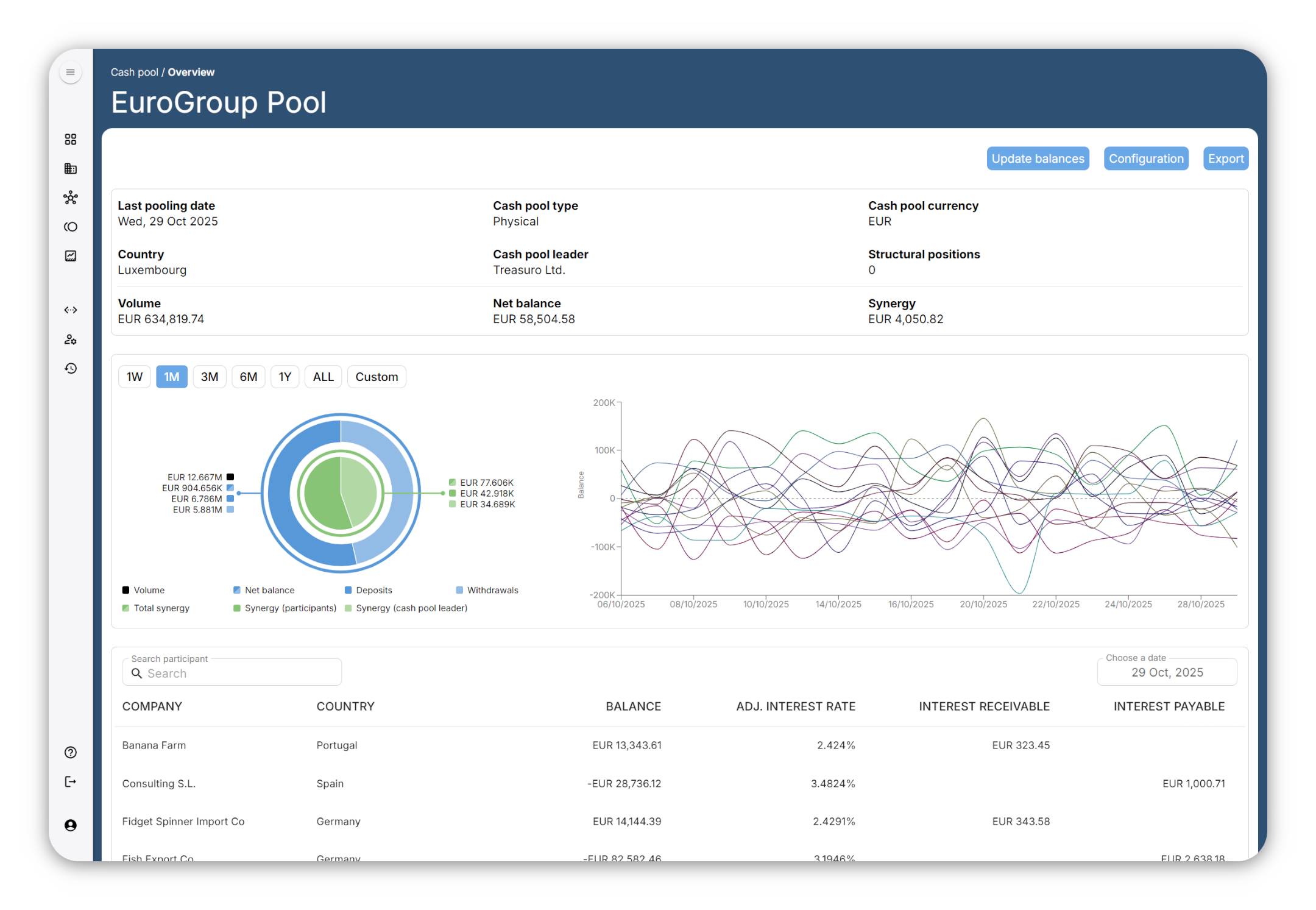
At this intersection of treasury and tax (transfer pricing), few tools exist that provide teams with both the ability to view and manage the liquidity in their cash pools, while also calculating arm's length interest rates for its participants - with spread and synergy-creation in mind. Tools like Synergen are specialised in this and provide treasury and tax teams with an effective solution. Synergen is not a replacement to a TMS suite, but rather a compliance tool, offering liquidity monitoring and analytics to treasury, while automating complex computations of synergy-adjusted arm's length interest rates and documenting the transfer pricing process for tax departments.
Whether you are considering implementing a group-wide cash pool or already have one in place, a tool like Synergen will enable your teams to focus on strategy rather than tedious compliance calculations to stay in line with OECD Transfer Pricing Guidelines. Get in touch or book a quick demo to explore whether Synergen is a good fit for you.